“Yer maun’ Joey Dunlop was many things.
The epitome of an enigma, this petite, often unkempt man, won more TT races than anyone in history had done before him.
Yet he hid, when possible, from the fame and notoriety that followed such success. Instead of chasing cameras, he would often be tucked away, looking over his bikes between practice and races, especially the oft-temperamental two-strokes. Or in the back of his van, despite being a factory-backed rider with mechanics, hospitality, and people to do that for you.
He could ride in mixed weather conditions like no other. He could jump from a 125cc two-stroke race machine to a 750 road-based bike in the same day and win. He rarely made a fuss, rarely crashed, and looked awkward in the limelight his skill and success afforded him.
Enjoy more classic motorcycle reading, Click here to subscribe to one of our leading magazines.
Joey Dunlop was loyal – to his family, whom he was regularly seen with, to his friends, his supporters and mechanics, his sponsors, and his teams. He stayed with Honda from 1980 until his death… he would load up his van and take aid to Bosnia or Romania – with no media involved – just to help.
In 2000, Dunlop wrote a chapter worthy of a film. Many had said he couldn’t win again on a big bike, that at 48 he was too old, and that the Honda VTR1000 SP1 wasn’t quick enough to beat the mighty Yamaha R1. But his loyalty paid off. Honda released a World Superbike engine… special parts and works Ohlins suspension. His skill, track knowledge and speed rewarded Honda with a fairytale win of more than a minute – and silenced his critics after Jefferies’ R1’s clutch exploded. He also won the 250 and 125 races that week, both on Hondas.
Just weeks after seemingly his greatest win at the TT, at a small race in Tallinn, Estonia, the unthinkable happened. After his TT hattrick, Joey was killed in a wet 125 race. Like many, I remember seeing the news in 2000, not knowing what to think. This man, our man, this icon, our icon, had been taken.
Honda RVF750R RC45
The RC45 was a true Honda and boasted many elements that were not afraid to break the mould. Yet it was always to be in the shadow of its predecessor, the RC30, and the 1000s that now ruled the roost. Fuel injection sat atop this low-volume, hand-built homologation special, operated by a then powerful ECU. A 16in front wheel (as on the early Fireblades), 190 rear tyre and top-spec Showa suspension kept the corners at bay, while the engine had all sorts of clever materials and coatings to keep friction and weight to a minimum. This was part endurance RVF racer, part NR750, part RC30. As standard, the bike only made 118bhp, but once tuned for the road, the 750 could make 160bhp.
But it didn’t change the world like the RC30. The Ducati were beating it on the track, and its low volume and high price meant it wasn’t a sales success. It did win a couple of WSB championships, but it wasn’t enough and the bike only lasted two years before Honda followed Ducati with a V-twin, the SP1.
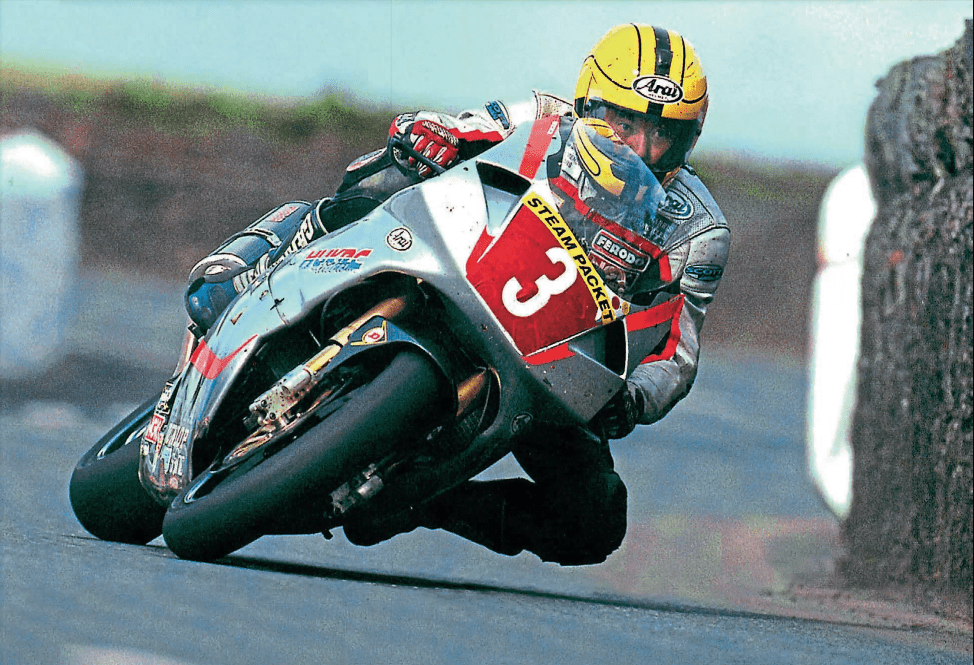
This is an unusual image of Joey and RVF750, from Church Bends at the Southern 100 race at Billown in 1999. The Honda UK club colours are similar to the bike Joey used to win the epic Ulster GP that year, but that bike had Lambert and Butler sponsorship on the front, so who knows. What we do know is that Joey on an RC45 was poetry.
Original article appeared in Classic Bike Guide Magazine. To subscribe please visit https://www.classicmagazines.co.uk/classic-bike-guide