Steve Cooper thought the end of the Japanese Street Scramblers series he wrote for Old Bike Mart had come to fruition. Apparently not: A couple of months after writing what was supposed to be the final episode of the recent series, up pops one of the most bizarre and oldest street scramblers ever.
If you’re a fan of small bikes in general, and Hondas in particular, you’ll be aware of the Super Sports CB92 Benly. Based on the so-called cooking version of the CS92 (aka CA92 in the USA), the little 125cc twin pretty much rewrote the rules for one-eighth litre motorcycles. For a handful of years this mighty midget inspired young and old riders alike, performing way better than any tiddler had before it whilst looking like nothing else.
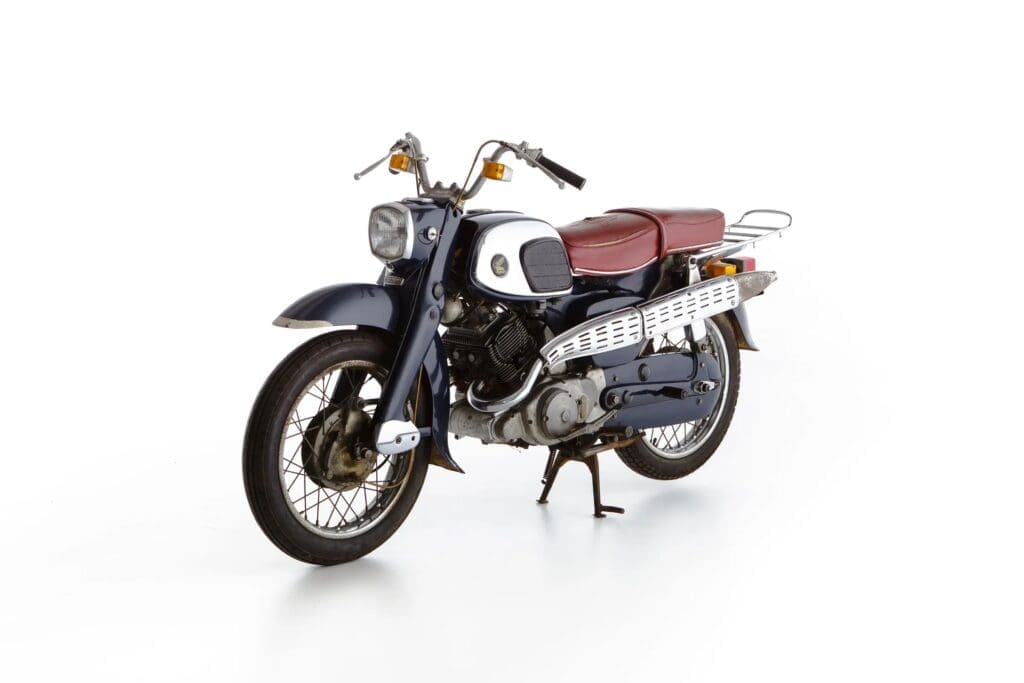
When the Super Sports CB92 Benly was released into the Japanese home market there was already a keen interest in what we would now recognise as street scramblers. Therefore, the bike that catalysed this (very) final episode of our series was almost a foregone conclusion in many ways. Taking elements of the base model, Honda grafted on a pair of high-level exhausts, fitted a bright red seat, raised ’bars and then painted the all dark blue before calling the resultant machine a CS92. A period brochure written in English shows the C92/CA92, the CB92 and the CS92 all available for dealers to stock. However, sadly it seems highly unlikely that any of Honda’s overseas agents would have imported a single example of the super cute CS92. I looked and the trouble with these internet sponsored wormholes is that the further down you go the more obsessed you seem to get – or is that just me?
Enjoy more classic motorcycle reading, Click here to subscribe to one of our leading magazines.
Honda had built a raft of 250/305/350 twins from the late 1950s onwards and slowly moved away from the older dry sump engines to the later wet sump power units that would come to symbolise the marque from the 1960s onwards. Generically sold as C series twins and carrying the Dream moniker in sales catalogues, there were soon street scrambler versions on offer. In both CS71 (250) and CS76 (305) guises they carried styling cues shared with the CS92 and aimed primarily at the home market where they sold well. With the change of engine design came the C72 (250) and C77 305 which were swiftly followed by high pipe/high CS72s and CS77s street scramblers.
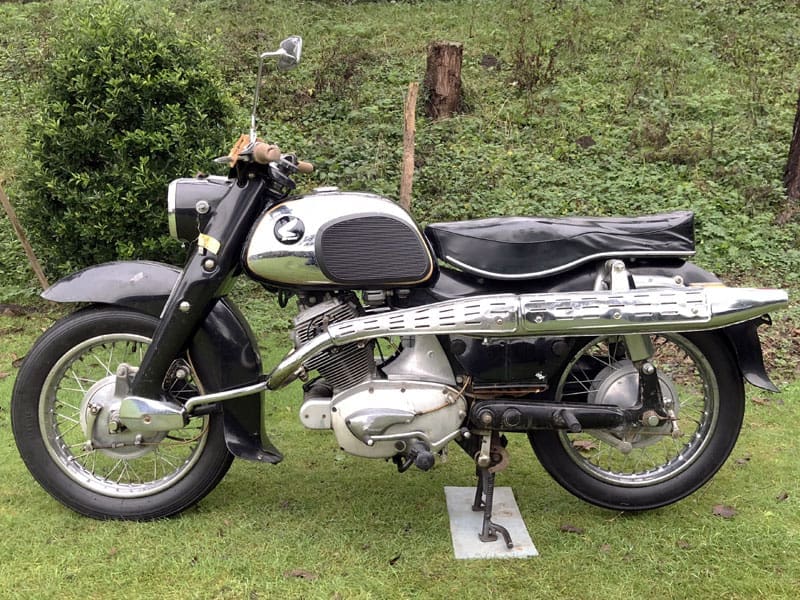
From what little data there is out there in the public domain – and there’s not much – it doesn’t look likely many of the earlier CS71/CS76 models made it out of Japan. Apparently there’s a handful in the USA but most of these are likely to have been brought back by American troops returning from overseas service in Japan. Typically these earlier dry sump twins feature the almost horizontal, pressed steel handlebars that carry small, semi-integral, indicators. The later wet sump CS72/77 bikes that were officially exported to the States would go on to have much higher tubular chrome plated ’bars to which larger cast alloy indicators were attached via double bolted clamps.
Ultimately the C72/77 and their CS street scrambler siblings were soon to be consigned to history with the designing, prototyping and introduction of all-new CB72/77 range that was to be unveiled for the 1960 model year. Honda would move on from the remnants of its C/CS twins in short order and, temporarily at least, cease offering street scramblers.
However, that decision was then swiftly reversed come 1962 when Honda USA asked the parent company for a competent dual-purpose version of the supremely popular CB77 Super Hawk and the result of that request led to the famous CL77 being produced for the American market. It was part road bike, part scrambler and proved where this series on street scramblers began some 20 issues ago! And that is my last word on the subject … possibly!