Reviled, slandered and libelled then and now, Steve Cooper sets the record straight about a once much-maligned machine: Yamaha’s XS400. It can’t be that bad, eh?
WORDS: Steve Cooper PICS: Gary Chapman
How does that old saying go: ‘Believe half of what you see and nothing of what you hear?’ I think that’s it…The world of classic motorcycling is full of empirical statements, definitive statements, rash assumptions and downright lies. This is why some will argue that, say, you’d be mad to waste your hard-earned cash on a Suzuki GT380 when a Kawasaki S3 is obviously the ‘right’ choice. Logical– hardly, balanced – certainly not, pragmatic –don’t make me laugh. We all have our preferences and reasons for buying certain bikes, but we’d be lying to ourselves if we reckoned that we always make cogent and impartial decisions. And by the same rationale it’s exceptionally easy to jump on the bandwagon and accept that perceived wisdom is automatically correct wisdom when it comes to so-called lemon motorcycles. Give a dog a bad name, etc.
Enjoy more classic motorcycle reading, Click here to subscribe to one of our leading magazines.
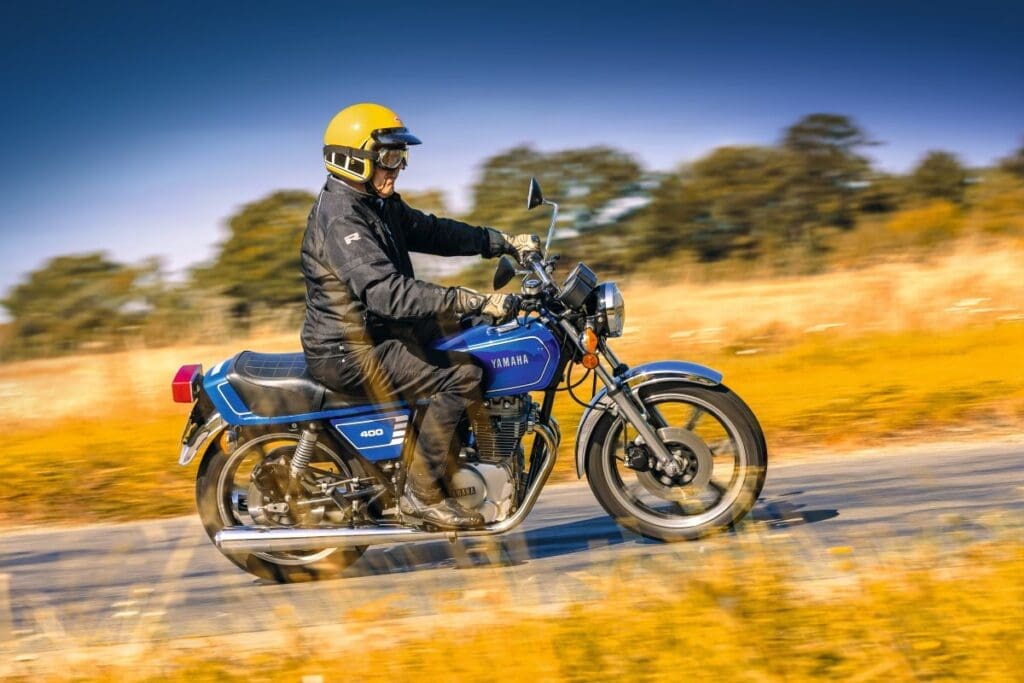
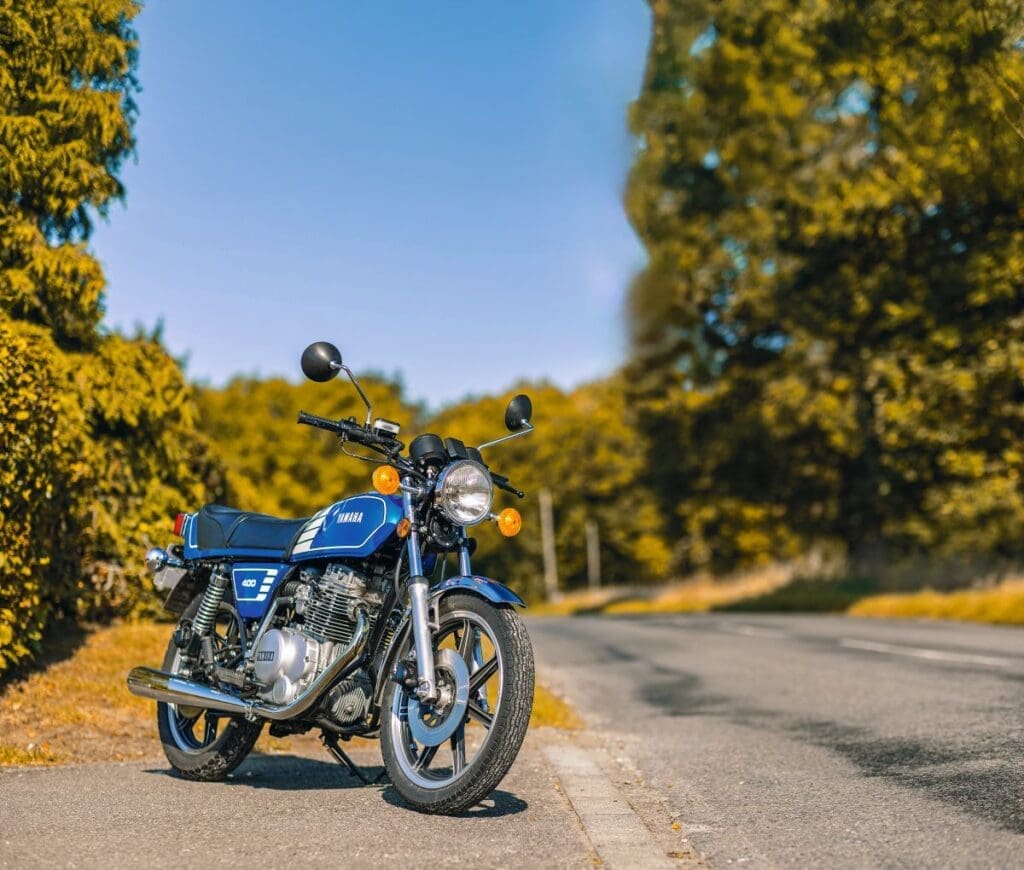
Which is why, partially in the name of ‘investigative journalism’, partially out of interest (and most definitely because I’ve never had the opportunity) I’m sampling Dave Lancaster’s stunning XS400. Plotted up outside a country pub basking in some much-needed summer sun, the mid-candy blue twin looks like a cracking piece of kit.
Those decals aren’t classic Yamaha speed block yet they have a sort of inference towards the iconic markings. The bike’s profi le may not quite be RD400 but it’s not exactly a million miles away either. Yes, okay, the bike has a single front frame tube running from the headstock down to the engine cradle but other than that there’s a lot of familial points of reference.
And, of course, there would be because the bike’s creators were never going to reinvent the wheel for a pair of models – the XS250 and XS400 share an awful lot with numerous other models. Doubtless if you deconstructed the chassis you’d find it takes a lot of its design cues, joints, welds, brackets, pivots, bearings and rubbers from every other contemporary Yamaha.
Sorry, fans of Iwata stink-wheels, but the XS400 shares a hell of a lot of the RD400’s DNA: yes, yes, yes, other than the ‘heart of the matter’: the engine.
For all its perceived shortfalls, deficits, faults and lacklustre reputation, the XS400 would have shared shop floor space, creative input, resources and build time with the legendary two-stroke twins. The assembly workers probably would have had no overt preferences for either machine and the factory’s accountants would have assiduously cheese-pared to the same level regardless of the number of cycles made by the pistons. In fact, many at Yamaha HQ would have seen the XS as being the future, given that two-strokes were supposedly on the way out. Probably the only members of the team likely to have shown a preference would have been the road testers; we all know which one ultimately gives the rider the greatest thrill!
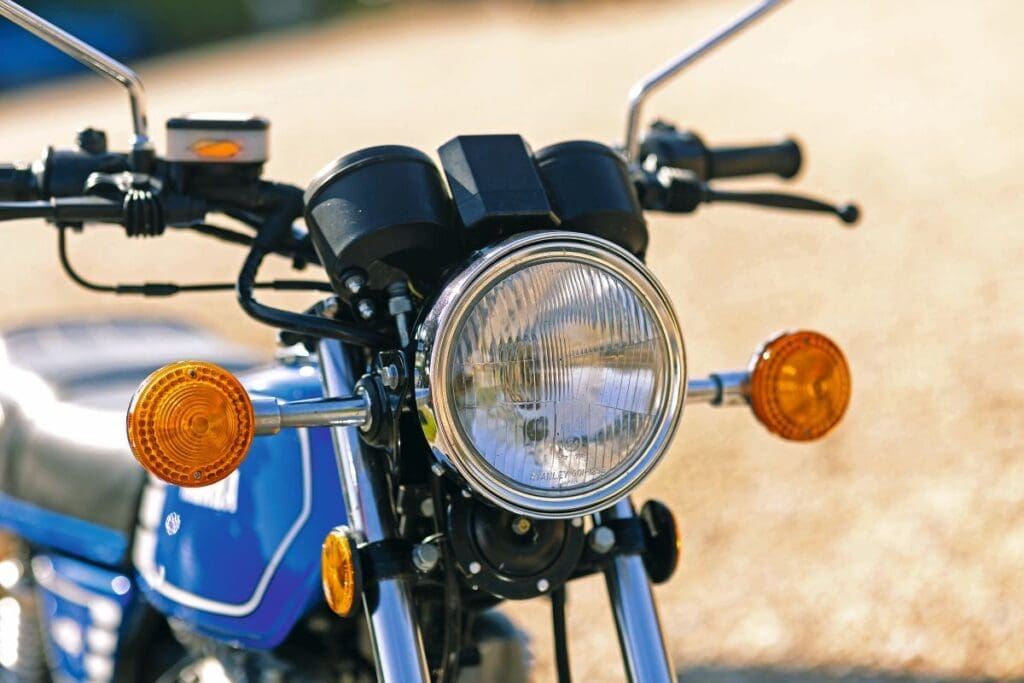
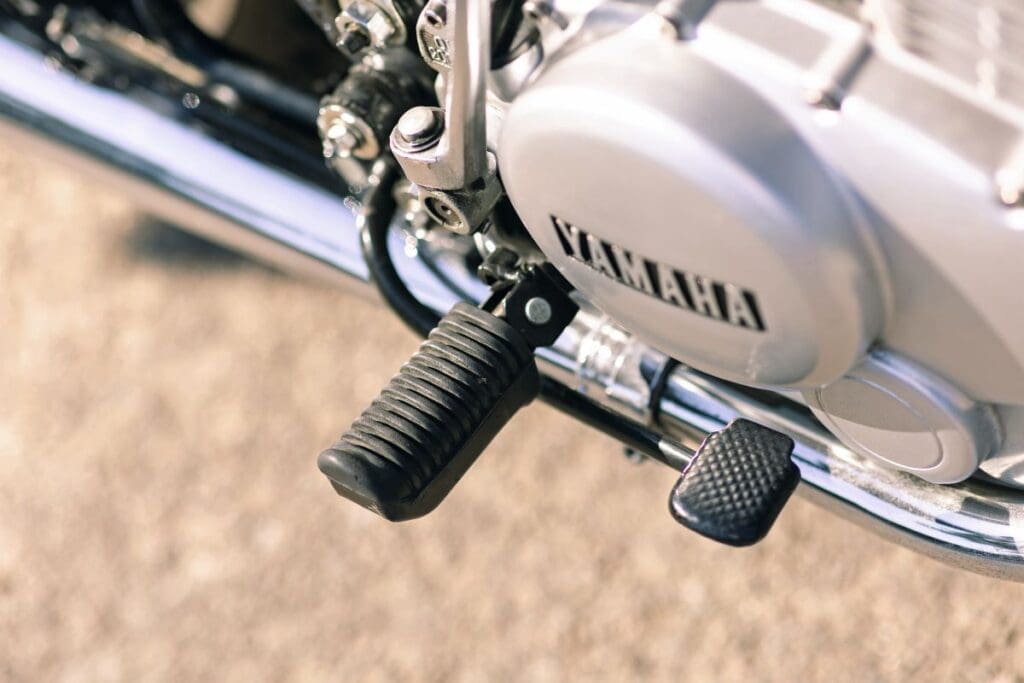
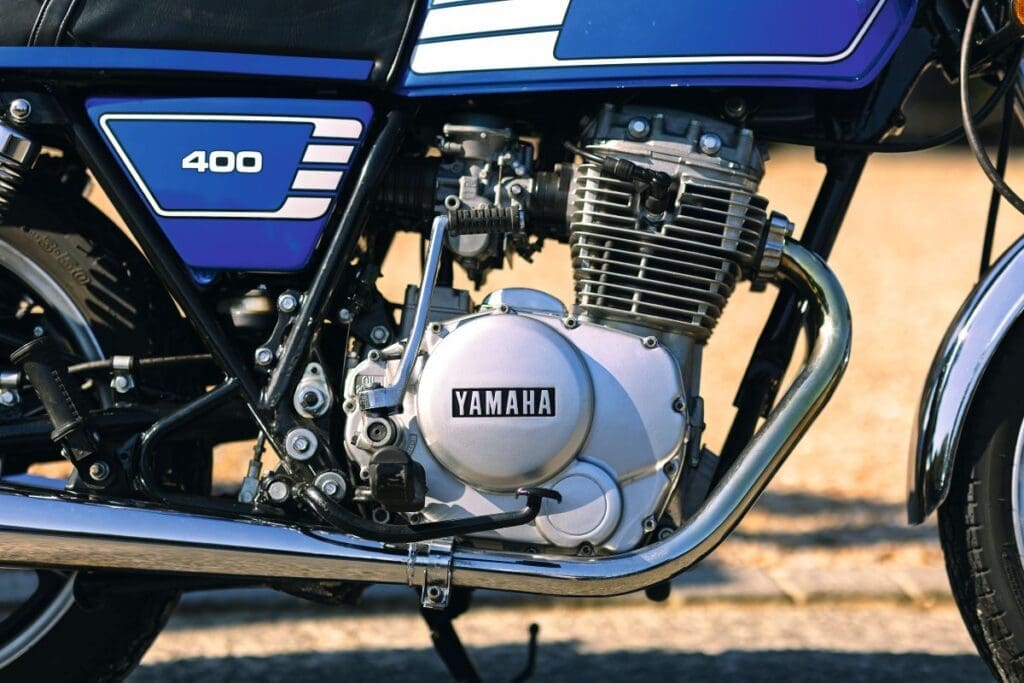
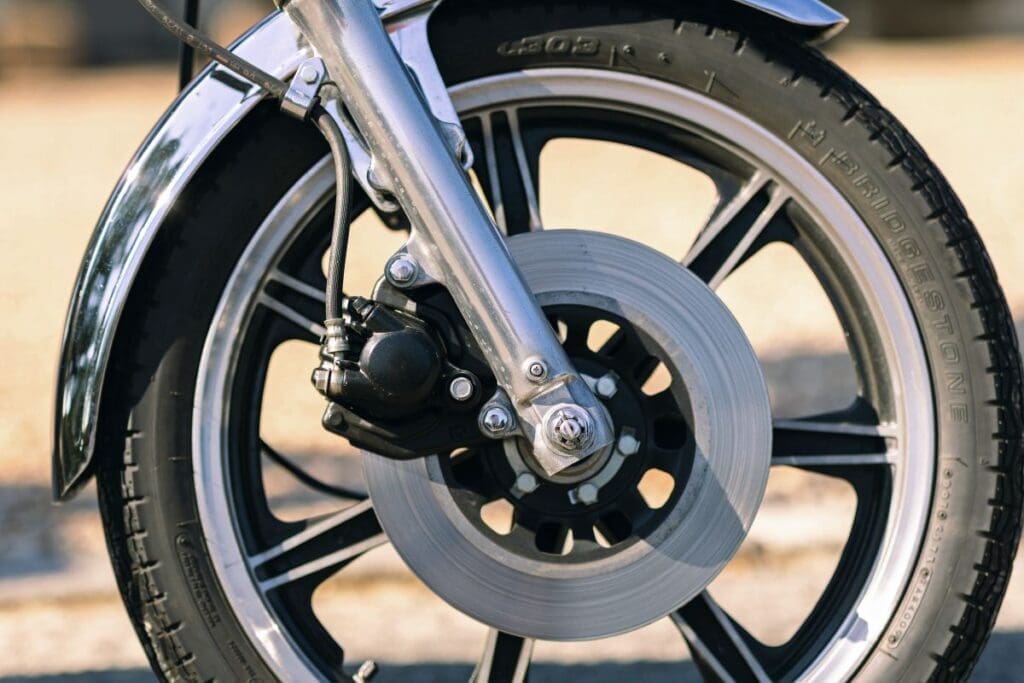
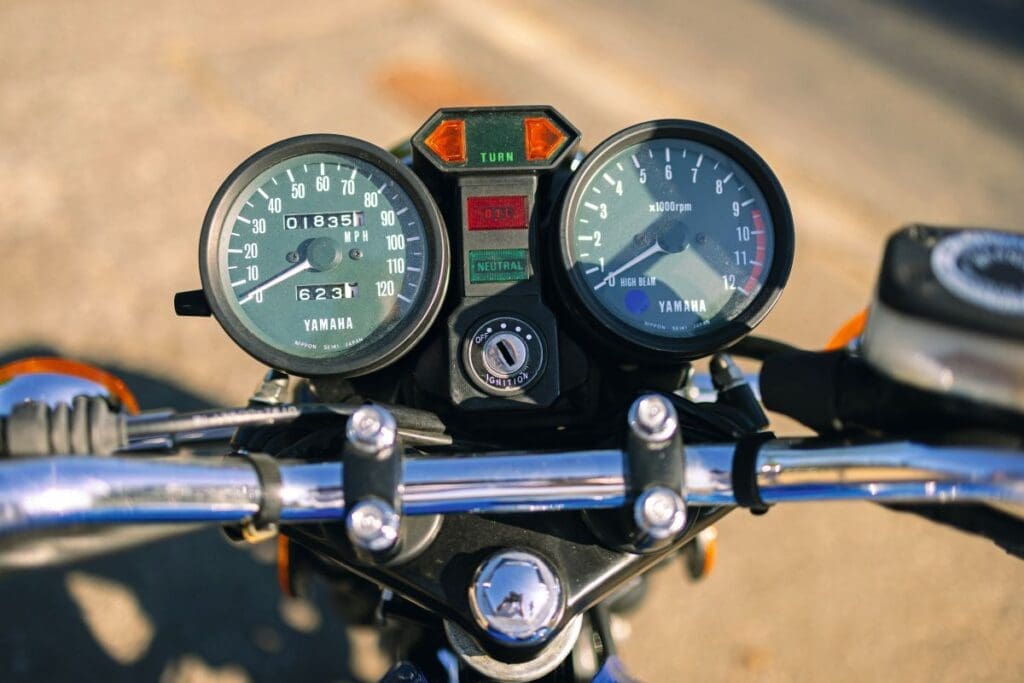
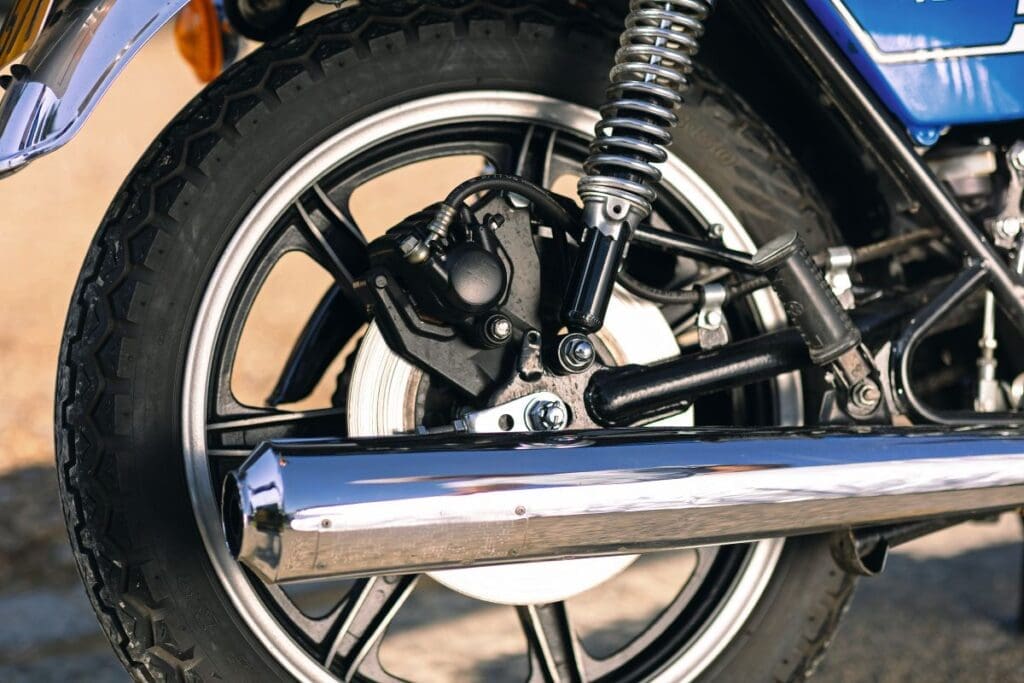
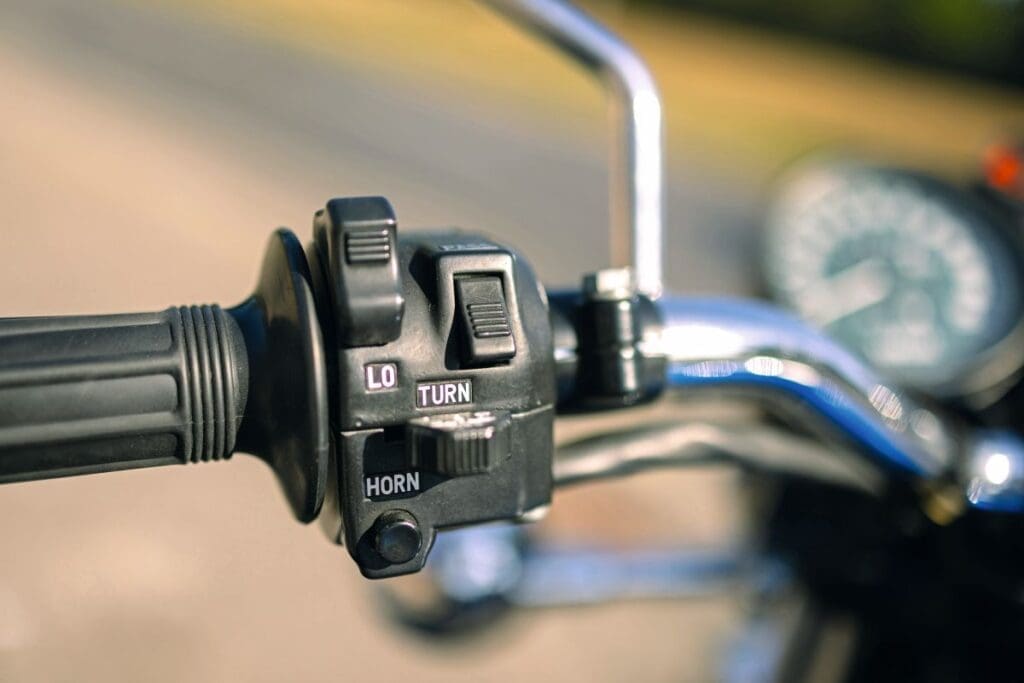
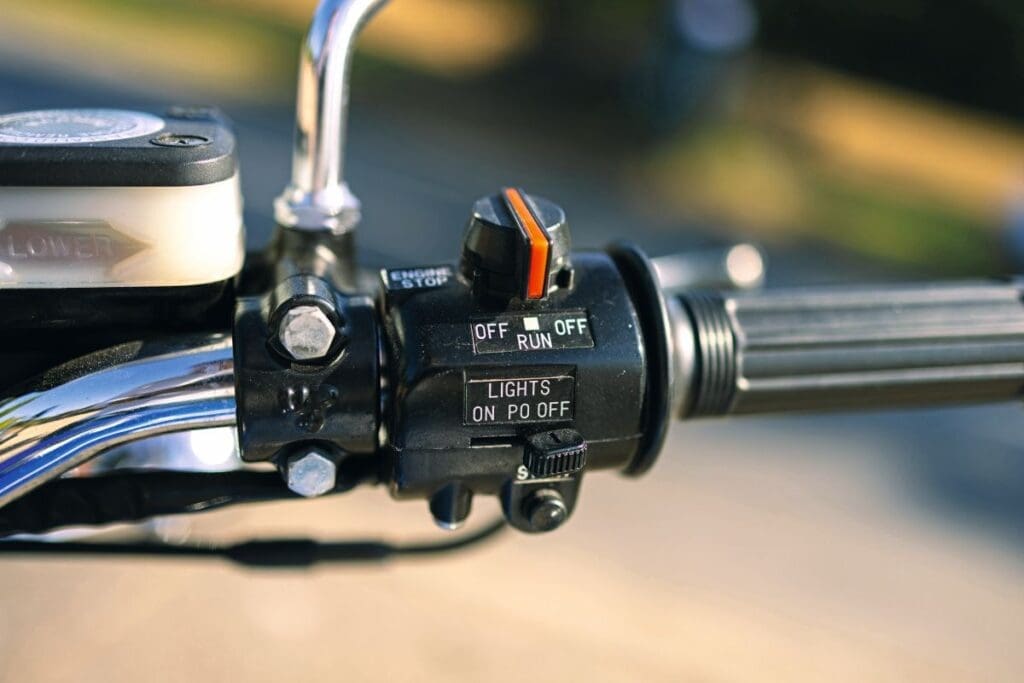
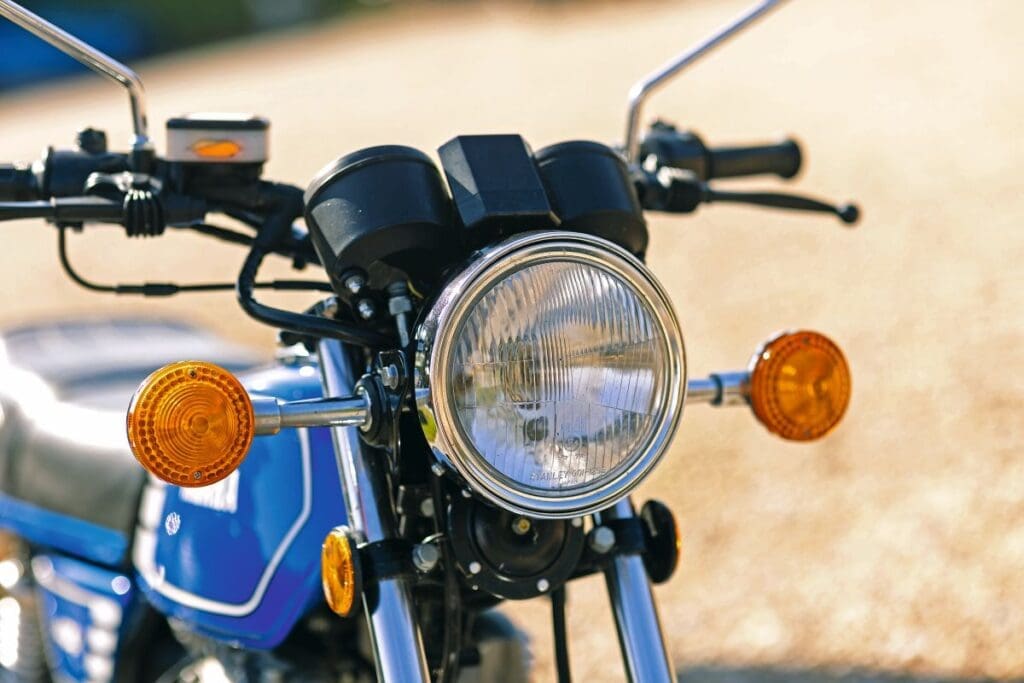
Mentioning the bean counters takes us on a quick look-see playing ‘Spot the Similarities’. Those guys in charge of the purse strings would have insisted wherever possible parts commonality be implemented. The entire dash looks hugely familiar for starters, wheels, calipers and brakes ditto, the switch-gear other than the starter button. Then, levers and mirrors are a given obviously; indicators, head and rear light: check! Then there’s probably a lot more besides. And even if these and other parts don’t automatically share the same reference numbers between RD and XS there’s a really good chance the ‘blanks’ pre-machining came out of the same third-party suppliers’ factories that sold into Yamaha. Sorry, haters of the XS400, but your RDs have a lot more in common than you might want to admit.
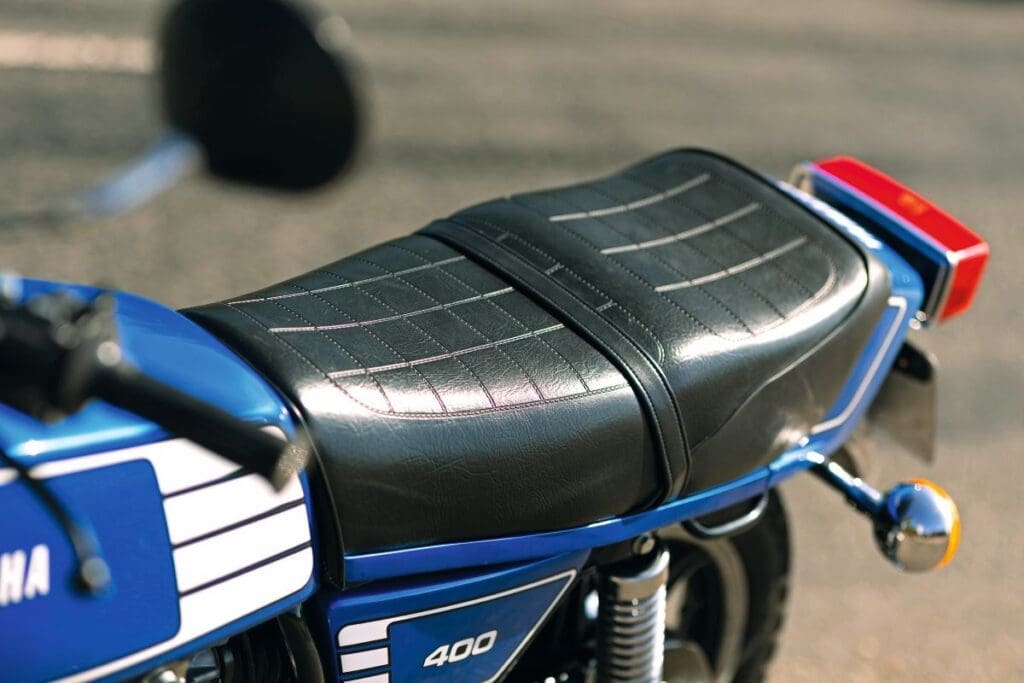
I’ll come out now and happily go on record to state I rather like the boxy styling of the bike. I’d go so far as to say it’s actually a handsome machine and the looks arguably suit it better than the later RDs (hate mail to the usual address please!) It borrows certain fashion notes of the equally loathed XS500 from some angles and it’s none the worse for that. If you’ve ridden a late 1970s Yamaha for any length of time, you’ll be instantly familiar with the general layout. However, one facet that’s not entirely expected is the seat which hinges from the left – perhaps as a sop to the intended American market where the bike sold in the highest numbers.
One small but interesting difference between the XS and RD is the location of the front indicators which still come off the brackets, but these don’t hold the headlight in place – strange. Being a four-stroke twin, rubber mounts abound: but it’s not a knee-jerk reaction – Yamaha had used a very similar system on the XS1/2/650 from 1970. Throw a leg over it and the 400 feels remarkably petite; this seems to be something of a Yamaha thing. Unlike Honda’s various CB twins that come across as small(er) motorcycles aspiring to be bigger ones, many Iwata twins, two- and four-stroke, seem to major in being ‘minor’ which is a rather neat trick.
One area where the XS400 does mimic the ubiquitous Hondas is in the bottom-end department. The crank is a 180-degree affair which offers less in the way of the bad vibes traditionally associated with parallel four-stroke twins. The Big Aitch had pretty much pioneered the layout with the CB450 Black Bomber and Yamaha happily tagged along. At this stage Yamaha was really trying to beat Honda at its own game so it’s no surprise to find the XS fires up immediately the starter button is actuated. As everything is still warm from the ride to our photo-shoot location there’s no need for the pull-out choke and the engine rustles away happily enough. There’s an off-beat note to the exhaust as each piston hurtles past its neighbour in the opposite direction and, perhaps not too surprisingly, some auditory similarities to a raft of CB twins.
On board, the forward view is generic late 1970sYamaha pure and simple; everything is where you expect it to be and requires no learning or compromises from the rider. Into first, out with the light clutch and we’re away accelerating and working our way through the six-speed transmission.
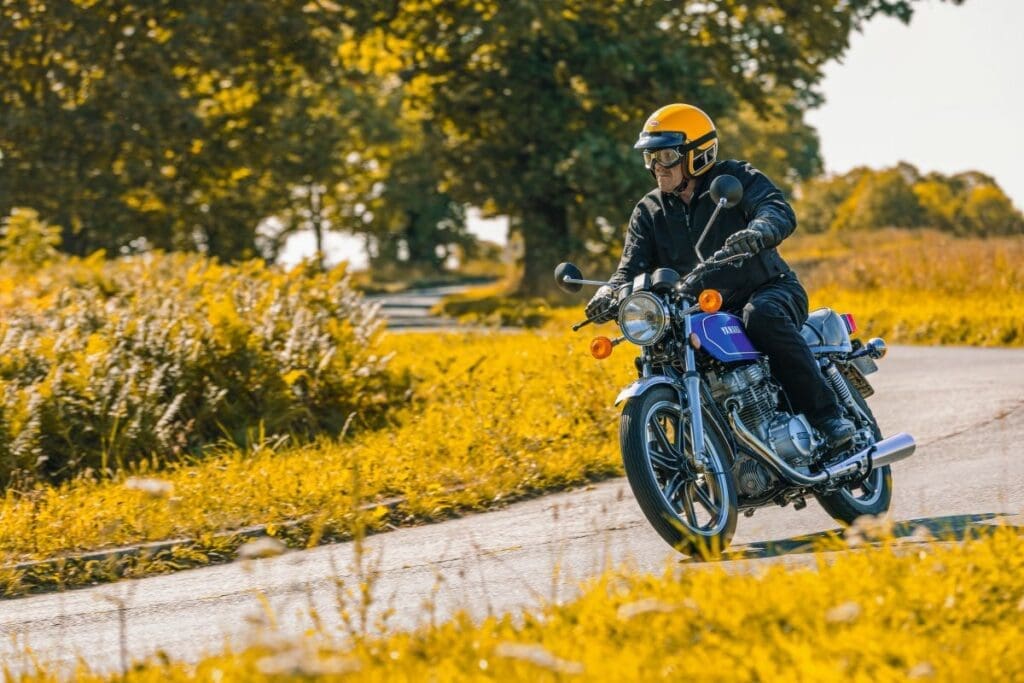
The XS400 is an absolute doddle to ride and it’s easy to see why many in the US of A chose one as their first road bike. It’s exhilarating without being threatening; doesn’t do anything you’re not expecting; gets up to decent speeds fast enough; and stops when you ask it to. Analogies to a well-known brand of fence paint would be entirely appropriate here. And, yes, RD400 owners, it will never, ever get the hairs on the back of your neck to stand up. It probably won’t wheelie easily or do a stunning stoppie either. It’s a Yamaha 400 made to an entirely different remit and none the worse for it.
Get the tacho past 4500 revs and the motor starts to shed some not particularly intrusive vibes out and by the time the needle is at 6000 it becomes remarkably smooth. Keep it on the boil the way Yamaha intended and the motor is a peach.
The handling feels surprisingly precise and why shouldn’t it? The same technology that went into the RD chassis was metered out to the XS in equal measure. Country backroads with ambiguous repair patches, bends with varying cambers and even a good old-fashioned hump-back bridge have no untoward impact on how the XS400 tracks. In fact, I’d go out on a limb and say it actually feels a little ‘tighter’ than some RDs I’ve sampled…hush my mouth.
The brakes are effectively the same as those fitted to the two-strokes and work in exactly the same manner. The seat is genuinely comfortable; the riding position is better than many; and the whole thing feels remarkably well-engineered. I came away from my morning on Dave Lancaster’s bike wondering quite why I’d never sampled one before because I was genuinely impressed; the experience is so much better than the old wives’ tales would have you believe.
The XS400 received undue flak almost from the day it was launched and very often simply because it wasn’t a two-stroke RD. Comparisons need to be made on a like-for-like basis or they’ll always be biased! On timelines the Yamaha here sits between the old Honda CB350 K series and later CB400N but, when it was current here in the UK it was always evaluated against the ubiquitous Super Dream.
The XS400 was Yamaha’s serious take on a middleweight twin and they undoubtedly went tooth-and-nail through numerous Hondas to improve upon them. Honda’s three-valve ’Dream was a sea change design for the capacity bracket and laid down a new set of standards…simple as that.
The XS400 never was a rocket ship but it was never a lemon either. Caught between a rock and hard place, Yamaha’s first attempt at a 400 twin was a damn fi ne effort and really doesn’t deserve the reputation it seems to carry. Despite having undeservedly earned winter bike status it’s most certainly not a dog of a machine. They are now being appreciated in standard format and worth tracking down if you can find one for a test ride. If you can park your prejudices, put a brake on your bigotry and recalibrate your reservations, you might very well come away enlightened and impressed.
Yamaha XS400 Genealogy
The XS400 stems from Yamaha’s heightened awareness of the growing pressure placed on two- strokes within the USA and particularly California as the 1970s ticked by.
1976 had seen the XS360 rolled out to the vital American market as a direct rival to the Honda twins of the time that had proved to be huge revenue generators; mid-capacity motorcycles had become huge business since the 1960s stateside.
1977 saw a lower-spec XS360 being offered alongside the ‘standard’ model. Drum front brake, no electric start, side stand only and other cost-cutting measures brought the retail price down by 20 per cent.
Boring the 360 motor out delivered the 400 during the same year with the 360 deleted for 1978. Come 1980, the XS400 gained an SE suffi x and a factory custom makeover look which kept it generating a decent enough revenue despite showing its lack of development; these faceliftmodels were variously sold as Special, Special II, and Heritage XS400s.
In various formats the old XS400 soldiered on until 1982 but various iterations were still being dribbled out in some markets a few years later and sold as discounted hacks. That same year an all-new XS400 fitted with a DOHC (double overhead cam) motor was unveiled which borrowed technology from the various XJ series air-cooled fours.
With a spine frame, mono-shock rear suspension and no front down tube, the bike looked dramatically different to the old model. Sold in two formats (Maxim custom look and Seca sports styling), it ran for a few years before being quietly pensioned off.
More punchy and sharper looking than the old XS400, it was still perceived as being another anodyne middleweight twin.
Sales in the UK were never significant and an appalling low level of fi nish did it no favours. Yamaha had taken two bites at making a viable 400cc twin and hadn’t really got there.
Ironically, it would be the Japanese Domestic Market version of the SR500 single that would be one of the firm’s most unexpected successes. The SR400 was still bringing home the bacon as late as 2021 in some markets before emissions regulations finally ended its run.
The Owner’s View – Dave Lancaster
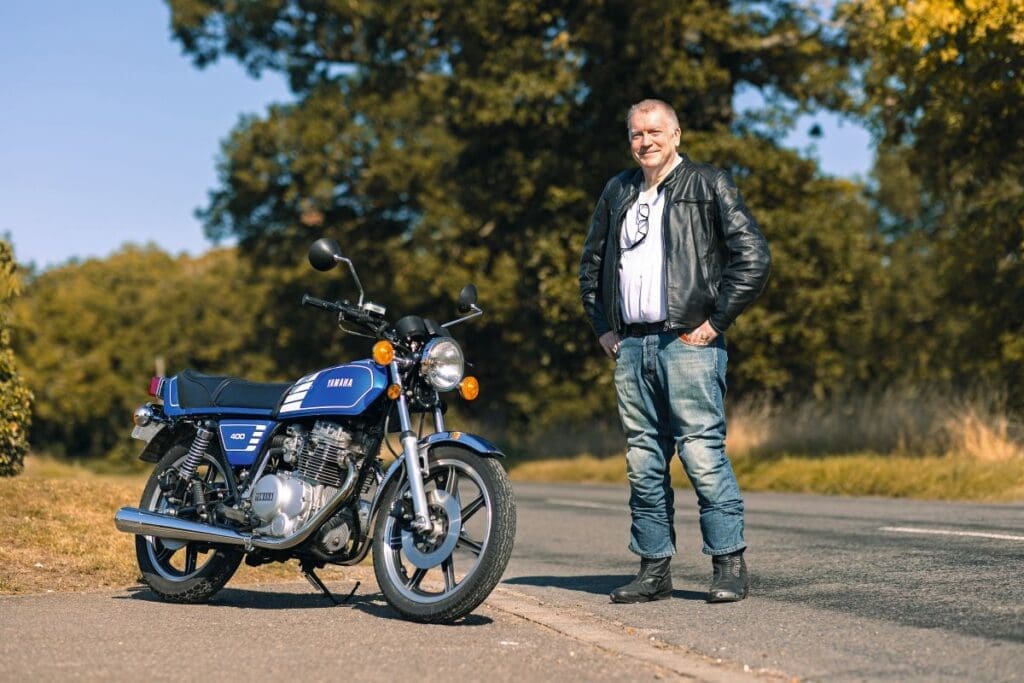
I’ve been the proud owner of my blue XS400 for almost seven of her 44 years; she was first registered in the summer of 1979.
I must admit I never looked at XSs back in the day and started my biking career totally wedded to two-strokes. I just wanted to get that out there before the XS haters chip in. My first proper bikes were an RD 125 and then an RD250 DX D (blue with alloy wheels), both from new. I’m currently the proud owner again of another RD250 but this time it’s something a bit more modern (an E also from 1978).
So how did I end up with an XS 400, I hear you ask? Believe me, I have been asked that same question many times. My standard reply is it was purely physical, and I wanted something blue and it had to be just as fast as the much more common RD400. I saw the XS pop up at Motorcycle Unlimited in Greenford and fell in love.
The bike was pretty much mint as anyone who has been to the Greenford emporium will know. All I had to do was change the end cans to some NOS originals a few years later, so she remains 100 percent original. Like all old girls she developed a smoking habit despite a nut-and-bolt rebuild from the previous owner a few years before my ownership. This was diagnosed as needing a rebore and new pistons to get her back to peak performance to keep up with those pesky RD400s most of us lust after.
Up stepped Mat Turnham from M Motorcycles in Biggleswade who did all the work for me, and she came back much faster than when she went in – I really can’t recommend Mat enough. Not only is he a top geezer, but also he can spanner a very eclectic mix of bikes from old girls like mine up to the more modern stuff. I like supporting local trades, especially fellow bikes.
She goes like a rocket now and has a new Wiseco heart. I’m just looking for some hungry RD400s: bring it on!
From the trade: Rob Pemberton of Skellerns and Spa Motorcycles
The XS400 was a lovely quick little bike and decent handler as well. The biggest issue was the timing, as they needed to be set up with a dwell meter and strobe. Basic points gapping and adjusted on the timing marks simply wasn’t accurate enough, but properly done they fly. There really wasn’t a huge amount between it and the RD to be honest; the biggest difference was that the two-stroke accelerated harder. As soon as the 10 year parts cut off came in at Yamaha’s spares facilities availability fell off a cliff; once the existing stock had gone, that was it. I’d not be wanting to restore one now!