
In this Opinion piece, first seen in Old Bike Mart, Bob Rolph reflects on materials, remanufacturing and responsibility when replacing or making motorcycle components. The article also includes a historical feature on the development of stainless steel.
Introduction
Do you often (or ever) think about how that replacement or pattern part was made, or what it was made of? Bob Rolph – who describes himself as ‘engineer, tutor and motorcycle fanatic’ – does…
Archive Inspiration
The archive article in the 60 Years Ago feature in the March issue regarding the use of better materials in motorcycle manufacture pricked a pet subject of mine and I thought it would be a great opportunity to put my thoughts and experiences out into the real world.
Enjoy more classic motorcycle reading, Click here to subscribe to one of our leading magazines.
As restorers we all find ourselves in situations where we need to replace, repair or remanufacture components for our pride and joy. In the ideal world we would visit the local motorcycle emporium and be presented with the perfect part from a brown-coated stores person who knew every part number off by heart!
How I long for those old days but, in reality, we are forced to trawl through the ads, internet or autojumbles in the vain hope that the last new unobtainium may still be out there.
Having Parts Made
The other option is to have it made, but where? There are loads of machine shops in this country, many containing the latest CNC, waterjet, spark erosion and 3-D printing equipment. The problem is that this type of machinery cost hundred of pounds an hour to run and the owners generally need a minimum number of parts to even consider making your unobtainium. Taking on ‘one offs’ are usually a real pain in the bum to these businesses. Consequently, their prices and lead times are sometimes set deliberately high, just to put us off!
I’ve had parts sitting on a machine shop shelf for months only to be presented with a poorly repaired outcome, along with the statement “Well, it’s only for an old motorbike!”
I know that there are some super skilled engineers and companies out there who make some unbelievably complex items, but unfortunately they are few and far between. Also, those old guys who can make anything in their shed are getting older and their hard-earned skills are being lost at an alarming rate.
A Real-World Example
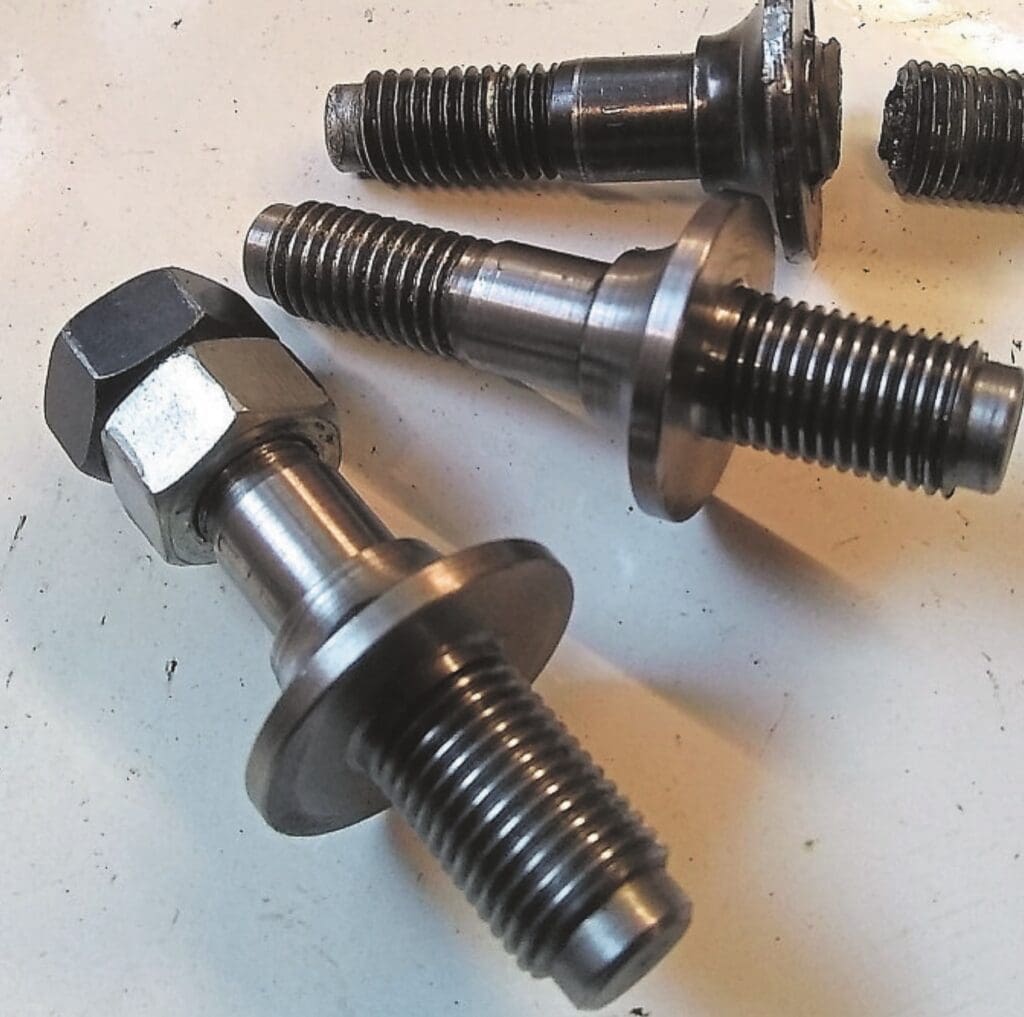
Here is just one example of what we can be faced with, looking from both sides of the coin: A race car restorer knocked on my workshop door, holding the remains of a special fixing stud that secures the suspension wishbone to the axle carrier of a classic racing vehicle.
When this part broke, the front wheel flopped out and the bodywork skidded along the tarmac until the car ground to a halt! Luckily all this happened at a speed that was controllable and no-one was hurt.
“Could I make a new one?” he asked? Well, yes, I can. But should I?
Anyone who is fairly competent on a lathe could also make this component. The problem is that, if this part fails again, especially at higher speed, someone’s life could be at risk. I then asked the gentleman if he had any specifications, drawings, etc, regarding this part and did he know what material it was made from?
He replied “No, but it’s got to be good metal!”
“Well, that’s easy then…” I remarked.
In reality he’s totally correct; it’s got to be good steel, but the original part was forged not turned from billet, so yet another complication to consider. He also remarked that if I didn’t take the job on then someone else probably would!
I hope the next engineer would have had the same reservations I had. Did I make a replacement part? Yes, I did, but I had to do a lot of research before selecting the best material, including any post-machining processes, to achieve the best outcome possible.
I also asked for material traceability from the steel supplier and a waiver from the customer stating that the part was made using different processes than the original component.
Would I make a bolt for an aeroplane? NO WAY.
Stainless Steel Considerations
Back to the article about stainless steels. What a great material, it doesn’t go rusty and looks like chrome when polished (apart from my shower rack that was stated to be stainless and now is running with red rust!)
Bob Currie’s article from 1965 is spot on – there are many grades of stainless steel and some are better suited to different uses than others. It doesn’t matter too much if we use the wrong material in unstressed areas, but having a swinging arm pin break is a different level of catastrophe.
In reality, how many re-made parts fail in use? It must be very small and most new parts can be made to a much higher spec than the original parts; as we all know, BSA or Triumph, etc, were manufacturing motorcycles to make a profit, not going for the best bike in the world prize. Consequently, material costs were a big concern.
Saying all this, I once asked a purveyor of shiny stainless parts at a large autojumble, “What grade of stainless do you use?” His reply was that he was not at liberty to say. I then replied, that, in that case, “I was not at liberty to buy them.”
Making Our Own Parts
I suppose this brings me to another angle regarding restoring and making our own replacement parts. How many of us use all original spec’d nuts, bolts, washers and brackets, etc? If I need a special stud or spacer, I’ll just fire up the lathe and make one, just like many restorers who now possess well-equipped workshops that allow us to machine and fabricate those parts that are just not available anymore.
There’s nothing wrong with this at all, as long as we just take a moment to source the correct materials. I always sketch out the important details and maybe even a sequence of operation before making swarf. It also helps to keep those old brain cells on track.
Even now after 50 years of machining I still make mistakes – I can just make them faster than most!
I hope these few words might help us all understand some considerations before making parts in the home workshop.
The history of stainless steel
Stainless steel might have seemed to readers of The Motor Cycle in the 1960s to be something of a new wonder material. But its history dates back to the 19th century when metallurgists first began experimenting with iron alloys in an effort to prevent rusting. While iron had a multitude of uses, it had one big drawback: corrosion.
Chromium had first been developed in 1798 and chromium steel was being used in both Sheffield and Germany as early as the 1840s. It was noticed, particularly by Englishmen John T Woods and John Clark that chromium alloys seemed resistant to corrosion and they filed a patent for ‘Weather-Resistant Alloys’. Later scientists came to realise that the less carbon chromium steel contained, the better resistance it had to acids.
However, it wasn’t until several years into the 20th century that a major breakthrough came. In 1913, Harry Brearley was a metallurgist in Sheffield, England, working for Brown Firth Laboratories, a research facility shared by two of Sheffield’s principal steelmaking companies. On August 20, 1913, while conducting experiments to develop erosion-resistant gun barrels he created an alloy with approximately 12–14% chromium and low carbon content, which he observed resisted rust far better than ordinary steel. It was the first commercial cast of stainless steel, although it proved to be unsatisfactory for gun barrels.
This was the birth of stainless steel although it should be said that several people had already created alloys that would effectively be stainless steel in the preceding years. One of those was Elwood Haynes who, in 1912, applied for a patent on a martensitic stainless steel alloy, although it wasn’t granted until 1919. Haynes, having already founded one of the first automobile manufacturing companies in the USA, formed the Haynes Stellite Company and was a millionaire by 1916 thanks to lucrative wartime contracts. He sold his patent for stainless steel to the American Stainless Steel Company in exchange for enough stock to gain a seat on the company’s board of directors.
Note from which Brearley came. Not only did his discovery revolutionise industrial manufacturing, but his hometown of Sheffield too, which quickly became the centre of stainless steel production. However, Brown Firth saw little future in stainless steel and refused to apply for a patent, deeming it useless. (In 1915 Brearley left the laboratory and he would eventually go into business with Elwood Haynes.)
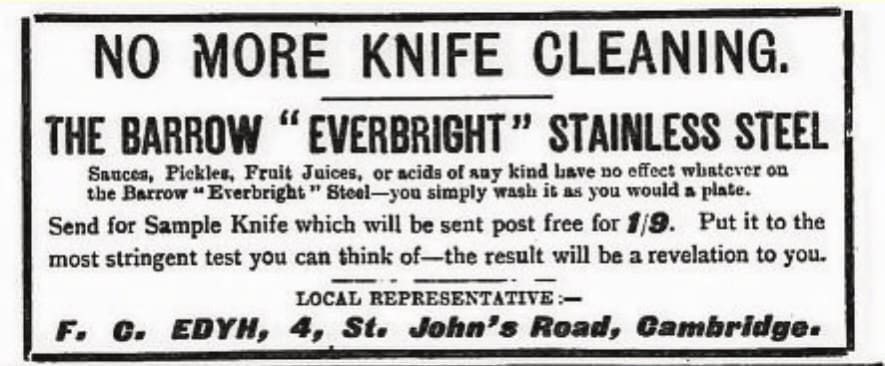
At first, this new alloy had a variety of names but it was Ernest Stuart of RF Mosley’s, a local Sheffield cutlery manufacturer, who coined the title ‘stainless steel’ and this was eventually the accepted name. Brearley had, just months after his first ingot was cast, been championing the material as ideal for cutlery.
After World War II, production greatly increased with new refining techniques making it easier and cheaper to produce. Now it’s used in every area of life, from watches and smart phones to surgical instruments and implants to buildings and bridges – and, of course, motorcycle parts.
Original article appeared in Old Bike Mart. To subscribe, click here: https://www.classicmagazines.co.uk/old-bike-mart